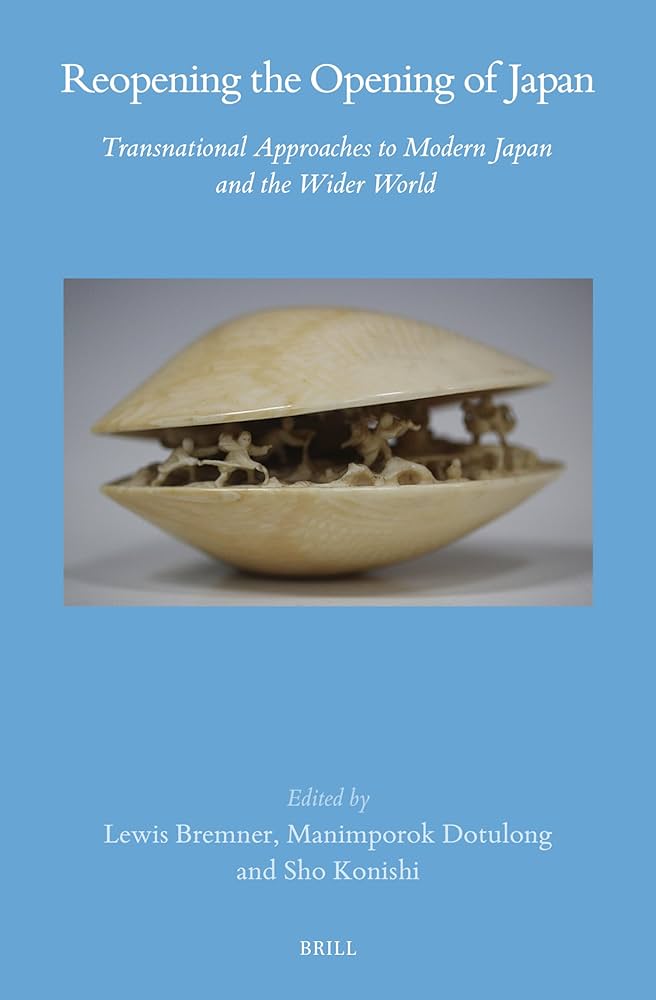
Reopening the Opening of Japan: Transnational Approaches to Japan and the Wider World
Brill, 2024
Editors: Lewis Bremner, Manimporok Dotulong, and Sho Konishi
The 'Opening of Japan' has been central to the retelling of Japan's modern history. Reopening the Opening of Japan fundamentally reconsiders what that historical moment entailed. What did intensified connections between Japan and the world mean both inside and outside of the country, and what does this tell us about Japan's historical significance on a global scale? The chapters excavate a rich array of surprising cross-border connections, from the global trade in mummified mermaids to the Japanese-Russian intellectual links underpinning the work of Akira Kurosawa. Re-thinking connectivity through non-state transnational perspectives, the book guides readers to new ways of doing and writing history.
https://brill.com/display/title/68978
Table of Contents
Acknowledgments and Permissions
List of Illustrations
Notes on Contributors
Introduction [by Lewis Bremner and Manimporok Dotulong]
Part I. Visions of Civilisation
Chapter 1. The 1860 Japanese Embassy and the Opening of American Civilisation: Samurai, Interracial Romance, and Southern Print Culture [by Natalia Doan]
Chapter 2. Laughing at Civilisation: Charles Wirgman’s Japan Punch and the Reopening of Great Britain [by Warren A. Stanislaus]
Chapter 3. Minakata Kumagusu and the Microbial Turn in Theories of Evolution and Civilisation, 1887–1892 [by Eiko Honda]
Part II. Life through the Opening
Chapter 4. Opening the West with Japanese Mermaid Mummies: Ningyo in the Making of the Theory of Evolution [by Mateja Kovacic]
Chapter 5. Hyakushō in the Arafura Zone: Ecologising the Nineteenth-Century “Opening of Japan” [by Manimporok Dotulong]
Chapter 6. The Transformation of Magic Lantern Technology in Nineteenth Century Japan [by Lewis Bremner]
Chapter 7. Squaring Experiences with the Opening The Case of Yokoyama Matsusaburō [by Maki Fukuoka]
Part III. From Particularity to Radical Universality
Chapter 8. The Modern Closing of a Tokugawa-Era “Opening”: The Early Modern Origins of an International Humanitarian Organisation [by Sho Konishi]
Chapter 9. A Defeated Samurai of the Boshin Civil War and the Search for a New Universalism [by Chinami Oka]
Chapter 10. Meiji Civil War Losers in Siam: Miyazaki Tōten’s Utopian Farming Community (1877–1896) [by Joel Littler]
Chapter 11. The “Second Ishin” and Kunikida Doppo’s Misunderstood Nature [by Yu Sakai]
Part IV. Epilogue: Postwar Reflections
Chapter 12. Something Like an Autobiography: Akira Kurosawa on Free Pedagogy and Restoration of Japan’s Democratic Self [by Olga V. Solovieva]
Index